


The state of IT security in Germany was tense to critical in the current reporting period. The Federal Office for Information Security (BSI) has thus assessed an escalation of the IT security situation, which had been considered tense in the previous reporting period. The reason for the reassessment were concerningdevelopments around the topics of artificial intelligence (AI) and exploitation attacks, which enable cyberattacks in unprecedented volumes and at unprecedented speeds. At the same time, many companies, authorities, and other organizations significantly overestimated their resilience to cyberattacks, often making it too easy for cyber attackers.
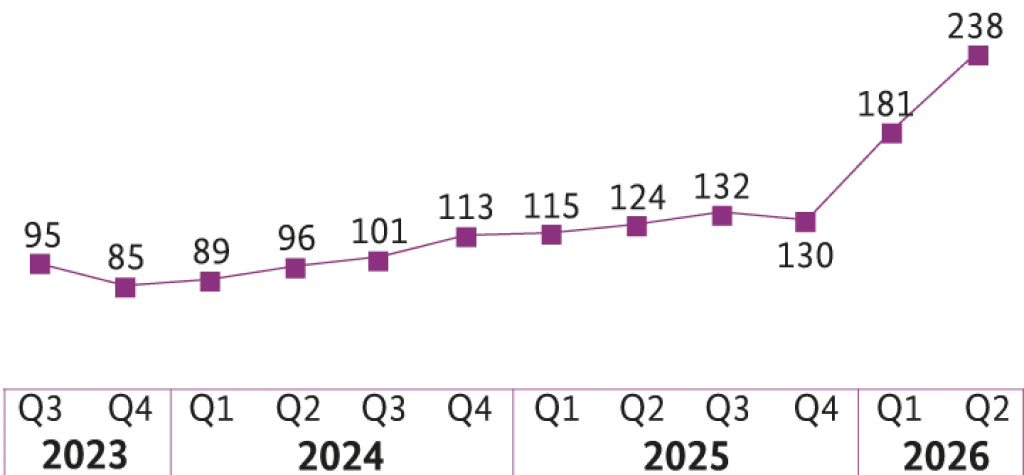
To quantify the IT security situation in the current report on the state of IT security in Germany, for the first time the BSI is putting forward the BSI Cyber Index. It consolidates the various dimensions of cybersecurity into a single normalized key figure — in the current reporting period, already based on the normalized scores for the development of attack surfaces (Attack Surface Score), threat landscape (Attack Score), and types of impact (Impact Score). The percentage changes refer to the previous reporting period. Rising index values indicate growing vulnerable attack surfaces, threats, and impacts.
Overall situation:
-
Tense to critical
-
- BSI Cyber Index: averaging 170 points during the current reporting period (up 50 % compared to the previous reporting period)
- Growing, vulnerable attack surfaces, especially through IoT and AI: up 117 %
- Increasing number of attacks, especially through exploitation attacks: up 48 %
- Highly dynamic through developments in artificial intelligence
- Resilience is only slowly improving: even foundational security measures are not or only slowly being implemented.
-
BSI Cyber Index | Unit: 2024=100 (measured value)
-
Image
 Copyright: BSI
The development dynamics in the current reporting period result from new vulnerabilities and weaknesses (up 35 %), particularly in web attack surfaces, which high-performance AI models can find and exploit in the shortest possible time. Significant increases in exploitation attacks (up 48 %) also had an effect on the BSI Cyber Index. Victims who were not well prepared against these attacks and paid a ransom after a cyberattack individually paid significantly more in the previous reporting period. The sharply increased ransom payments per individual case had a noticeable impact on the overall index.
Threats: Critical Dynamics
While a stabilization of the threat situation at a high level was observed in the previous reporting period, the situation took a critical turn in the current reporting period. Agentic AI based on large language models proved to be a high-performance component of the attack infrastructure that can do more than compose phishing e-mails: it finds vulnerabilities and simultaneously develops exploits to exploit them (exploitation). In addition, it can chain vulnerabilities into new attack vectors to an unprecedented extent. This not only facilitates the initial infection of a system but also the spread within a compromised network.
For several years now, cyber attackers have been increasingly focusing on exploitation. While the number of new malware variants distributed by e-mail is declining (down 20 % in the current reporting period), actors are increasingly shifting to exploiting vulnerabilities in systems reachable from the internet. A 57 % increase in scans for such vulnerabilities was observed in the current reporting period. Advanced AI, which scans for vulnerabilities almost fully automatically and generates suitable malicious code for exploitation attacks, will significantly accelerate this development.
Threats:
-
Critical momentum
-
- 57 % more vulnerability scans
- Additional momentum through AI agents as new attack vectors
- High threat potential for automated scanning and the creation of malicious code
The threat situation proved to be tense to critical during the current reporting period. This was due in particular to new AI-powered attack infrastructures that enable attackers to carry out cyberattacks in previously unseen volumes and speeds. Attackers have already significantly stepped up their reconnaissance activities, which they use to scout potential targets on the internet and prepare cyberattacks (up 57%). This dynamic is likely to intensify considerably.
-
Portscans am MADCAT-Honeypot
-
Unit: 2024=100 (measured value)
Image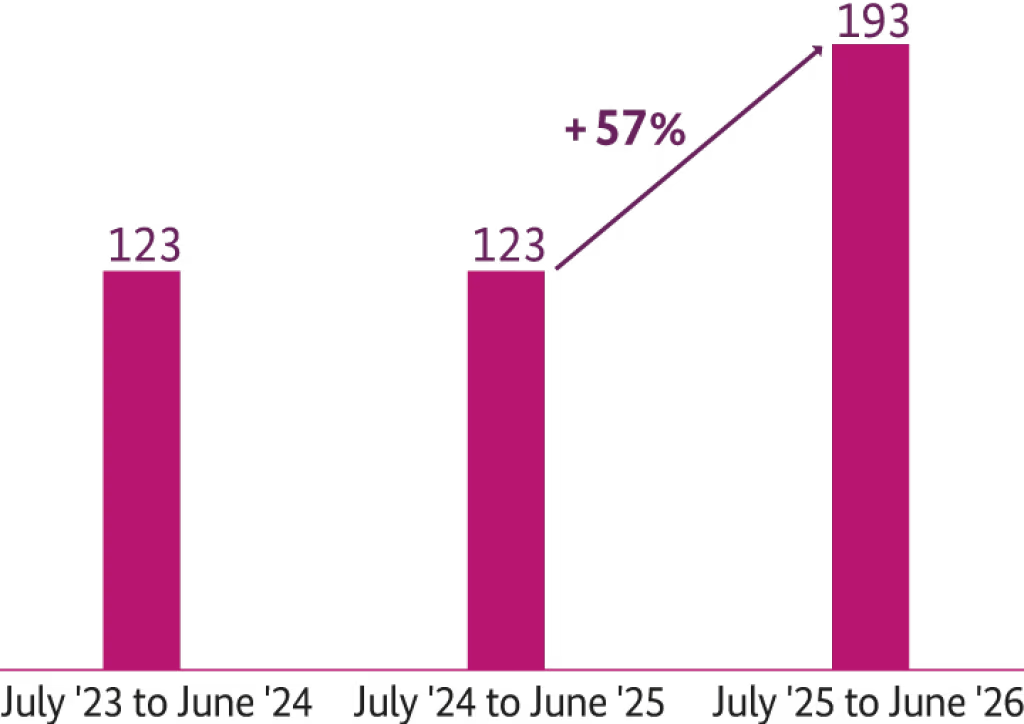 Copyright: Port scan statistics
Cybercriminals act opportunistically in this regard and select their targets primarily based on attack surface and vulnerability. A common approach is for attackers not only to encrypt the victims' data but to copy it beforehand as well, in order to additionally threaten to publish secret data (double extortion).
Attack Surface: Growing Attack Surfaces, Widely Exposed to Attack
Attack surfaces in Germany are steadily growing as part of digitization. Preventive measures are not growing sufficiently to protect them effectively.
BSI Attack Surface Score:
-
Up 117 % compared to the previous reporting period
-
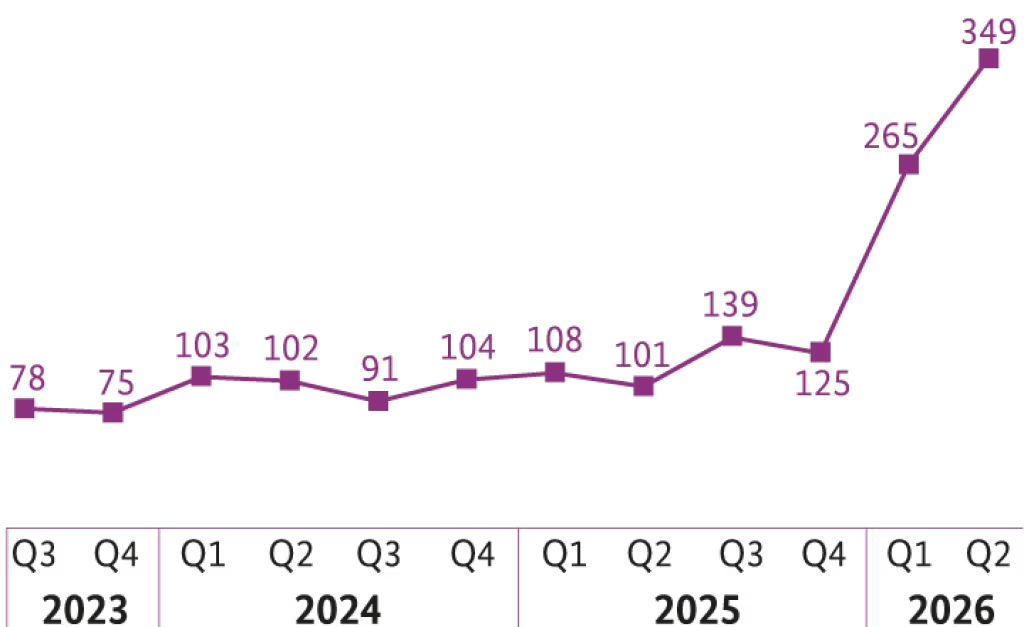
In the light of new AI attack vectors, identifying and exploiting vulnerabilities in systems that are accessible from the internet in record time, the vulnerability of attack surfaces in Germany has risen sharply during the current reporting period.
The Attack Surface Score has risen to 349 points in the second quarter of 2026 and was thus 3.5 as high as in the reference year 2024.
-
Unit: 2024=100 (measured value)
-
Image
 Copyright: BSI
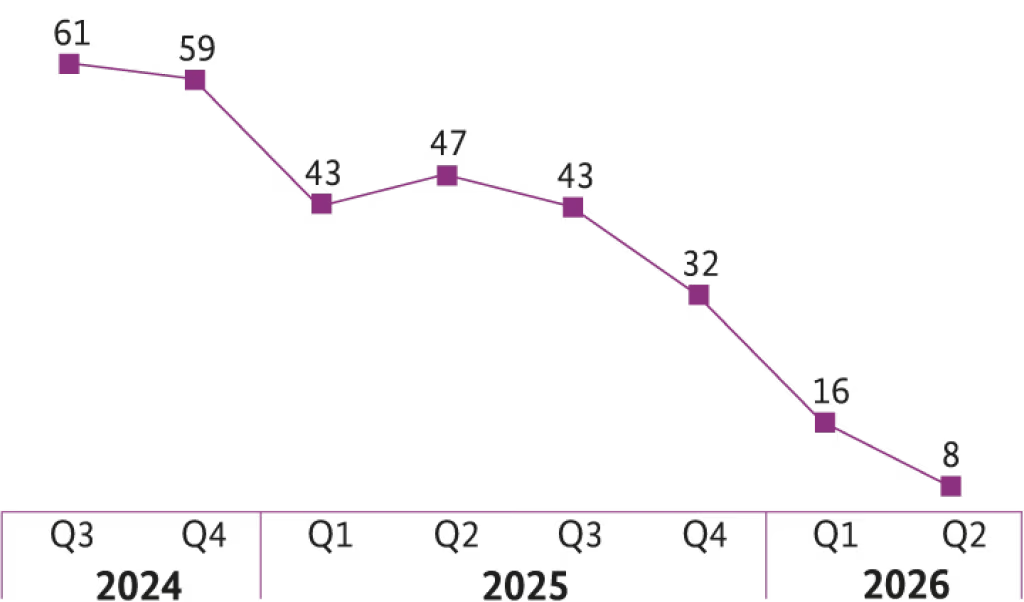
An average of 160 new vulnerabilities were disclosed daily. That was 35 % more than in the previous reporting period. Particularly concerning is the ever-shorter time span between the disclosure of a vulnerability and its exploitation (time-to-exploit). In the previous reporting period, an average of 53 days elapsed until exploitation; in the current reporting period, only 25 days; and in the second quarter of 2026, only 8 days — a decrease of 85 %. Advanced AI also has the potential to further accelerate this development. As described above, it can identify vulnerabilities and chain them automatically, enabling faster and more targeted attacks with higher potential damage and low costs.
Attack surfaces:
-
Growing attack surfaces, extensively vulnerable
-
Attack surfaces are growing quickly, esp. Through IoT devices, which are often poorly secured.
35 % more new vulnerabilities
Time-to-Exploit, i.e. the period between publication and exploitation of a vulnerability, decreased by 85% to only 8 days.
- Potential for further escalation due to AI
-
Time-to-Exploit | Einheit: Anzahl Tage
-
Image
 Copyright: Vulnerability Statistics | Created on June 30, 2026
The attack surface is growing particularly fast in the area of connected devices. According to forecasts, Germany will have a total of around 620 million connections from connected devices to the internet by the end of 2026 (up 22 % compared to the previous year), around half of which will be consumer IoT devices, i.e., everyday objects with internet connectivity.
Threat Landscape: Small and Medium-Sized Enterprises Are Particularly Exposed
When a threat meets an attack surface, a threat situation arises. Successful cyberattacks result from the interplay of cyber threats and poorly protected attack surfaces.
Across all attack types, the threat from cyberattacks increased in the current reporting period.
BSI Attack Score:
-
Up 9 % from the previous reporting period
-
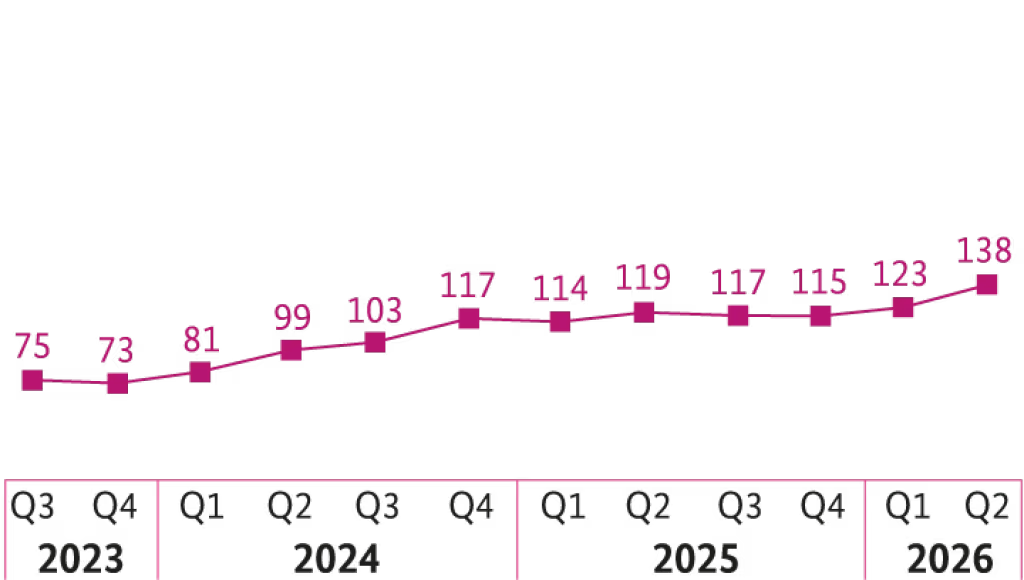
The Attack Score averaged 123 Punkten during the current reporting period. The key figure was thus 9 % abvoe the level of the previous reporting period. The noticeable increase in threats was especially due to exploitation attacks. Here a significant increase of 48% was recorded during the current reporting period.
-
Unit: 2024=100 (measured value)
-
Image
 Copyright: BSI
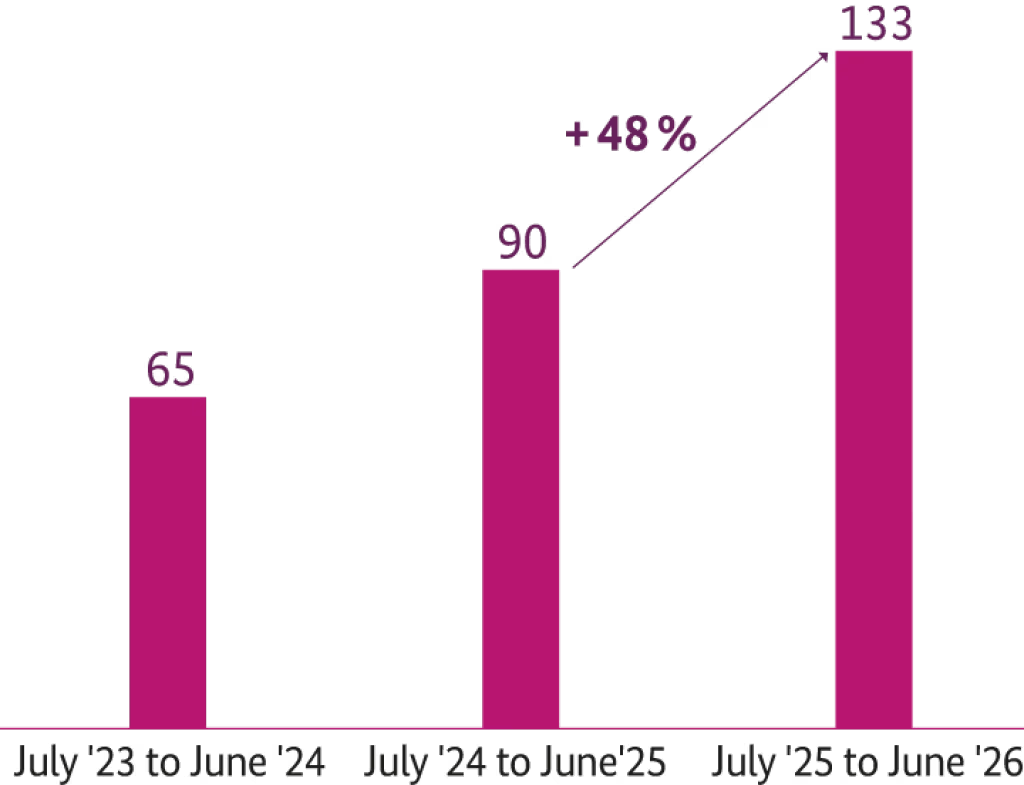
The growth of the Attack Score is due in particular to the sharp increase in exploitation attacks (up 48 % in the current reporting period). The qualitative development of the attack infrastructures is concerning: As early as autumn 2025, an automated attack using AI was observed. By the summer of 2026, AI agents had managed to break out of test environments in an uncontrolled manner and carry out exploitation attacks against uninvolved third parties.
Threat Landscape:
-
Strong growth in exploitation – SMEs especially at risk
-
- 48 % more exploitation attacks, i.e., by exploiting vulnerabilities in systems accessible from the internet
- 90 % of reported ransomware incidents involved SMEs (2024: 80%)
- 34 % more DDoS attacks, bandwith of those attacks increased as well
-
Exploitation attacks on the MADCAT-Honeypot | Unit: 2023=100 (measured value)
-
Image
 Copyright: Exploitation statistics
The number of DDoS attacks also increased, particularly in the second quarter of 2026. Unlike in the previous reporting period, the average bandwidth of these attacks also increased.
In the area of cybercrime, a moderate increase in the activity level of 8 % was observed in the current reporting period, and the number of police reports of ransomware attacks also increased (up 10 %). Small and medium-sized enterprises (SMEs) are particularly affected: In 2025, 90 % of the reported ransomware incidents affected SMEs (2024: 80 %). Nevertheless, many SMEs significantly underestimate their own threat situation and do not protect themselves sufficiently — making them easy targets for opportunistic attackers.
In particular, in view of automation and ever faster available vulnerability exploits, it is essential that even smaller companies invest in IT security. One effective measure is, for example, to deploy security patches automatically in order to close newly disclosed vulnerabilities as quickly as possible.
Types of Impact: Infected Systems Nearly Double
While some of the observed types of impact remained at a comparable level compared to the previous reporting period or even declined slightly, other types of impact increased significantly.
BSI Impact Score:
-
Up 33 % from the previous reporting period
-
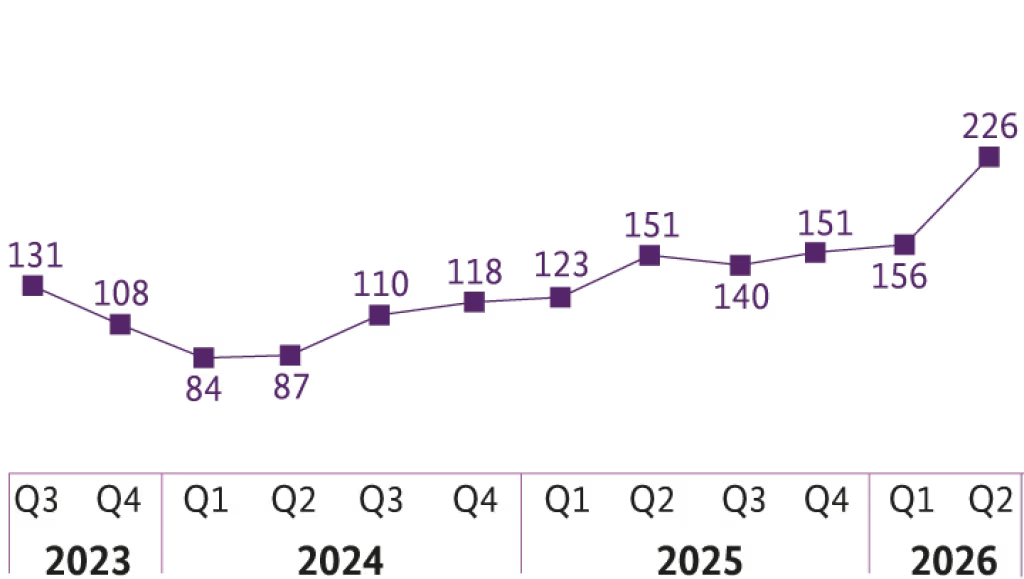
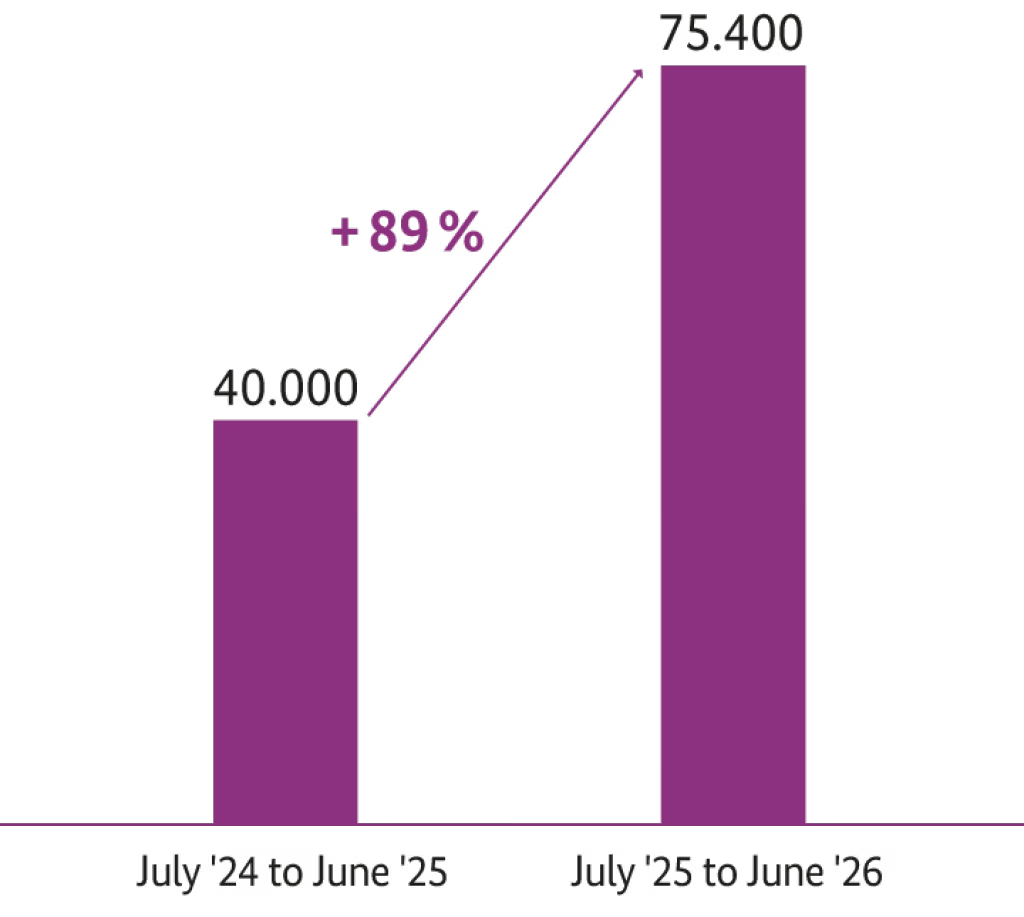
The BSI‘s impact score, measuring the extent of damages caused by cyberattacks, averaged 168 points during the current reporting period and was thus significantly above the previous reporting period‘s level (up 33%), with a new all time high of 226 points being recorded in the second quarter of 2026. While the ransom per case has heavily increased during the current reporting period, the overall sum of ransoms identified in blockchains decreased slightly. In contrast, the amount of infected systems in Germany has substantially increased (up 89%).
-
Unit: 2024=100 (measured value)
-
Image
 Copyright: BSI
The bright field of infected systems nearly doubled in the current reporting period. 88 % of the infected systems were Android devices — often Android-based consumer IoT devices. Due to "cut" security mechanisms, these are often easy targets for attackers, who link them into botnets and use them for DDoS attacks, for example.
Types of Impact:
-
Double the infected systems
-
- The known figure of infected systems in Germany almost doubled to over 75.000.
- 88 % of that: Android devices, esp. consumer-grade IoT
→ Attackers are building up attack infrastructure like botnets, to be used in attacks such as DDoS.
Note on the right-hand figure: IP addresses reported by the BSI to German internet service providers and other network operators.
-
Infected systems | Unit: Daily average number
-
Image
 Copyright: BSI
As with ransomware incidents, it is becoming increasingly expensive to skimp on security here too. Conversely, however, it is also evident: more and more organizations are sufficiently well prepared so that they do not have to cave to the extortion pressure of the attackers: In only 20 % of the incidents were the affected organizations willing to pay a ransom. However, the ransom payments per case reported by mitigation service providers rose to an average of around 1.9 million US dollars, so that the total amount of ransoms paid decreased by only 8 %.
Resilience: Progress, but too slow
As with ransomware incidents, it is becoming increasingly expensive to skimp on security here too. Conversely, however, it is also evident: more and more organizations are sufficiently well prepared so that they do not have to cave to the extortion pressure of the attackers: In only 20 % of the incidents were the affected organizations willing to pay a ransom. However, the ransom payments per case reported by mitigation service providers rose to an average of around 1.9 million US dollars, so that the total amount of ransoms paid decreased by only 8 %.
Resilience: Progress, but too slow
In the current reporting period, the resilience of Cybernation Germany was further increased in many places. However, this goal is still not being prioritized sufficiently, and potential improvements are being implemented too slowly. In the face of rapidly growing threats (for example, the sharply declining time-to-exploit), there is a risk of a growing speed gap between attackers and defenders. To prevent this, it is important to also use new technologies such as large language models (LLMs) as vulnerability scanners against cyberattacks, rather than leaving them to the attackers. For the first time, the defense side has the chance here, in the race with the attackers, not only to react but, by means of better defensive AI, to effectively protect IT products and infrastructures both in the manufacturing process and in operation.
Legal Framework: Cyber Resilience in Focus
Cybersecurity is making great regulatory progress — the current reporting period also saw several extensive regulations mandating compliance with minimum standards.
At European level, the Cyber Resilience Act (CRA) creates the obligation to design digital products to be cyber-secure throughout their entire lifecycle. In addition, exploited vulnerabilities in digital products must be reported in the future. Furthermore, the NIS-2 Directive adopted in 2022 was transposed into national law. The transposition law now obliges numerous companies and organizations to register, implement cybersecurity measures, and report incidents.
Economy: Many Companies Do Not Even Meet Minimum Requirements
Given the too slow improvement of cyber resilience in the economy, the transposition of NIS-2 comes just at the right time.
Small and medium-sized enterprises form the backbone of the German economy, but often have little to counter attacks. Although 90 % of the companies surveyed rated their cybersecurity as "good" or "very good," even those companies that subjected themselves to a BSI Cyber Risk Check — and who should therefore count among the particularly aware ones — met only an average of 55 % of the minimum requirements for protecting attack surfaces and limiting impacts in the event of an incident.
Resilience:
-
Progress, but too slow!
-
- Quick responsiveness is necessary, i.e. through automation and defensive use of AI
- Minimum standards are increasingly becoming legally binding: CRA, NIS-2…
- Implementation often sluggish, especially in the unregulated economic landscape, at the same time potential targets overestimate their capabilities
- Less than half of all consumers are using basic security measures.
- Necessity to consistently implement minimum standards
-
SMEs based on self-assessment and CyberRiskCheck
-
Unit: Shares in per cent
Image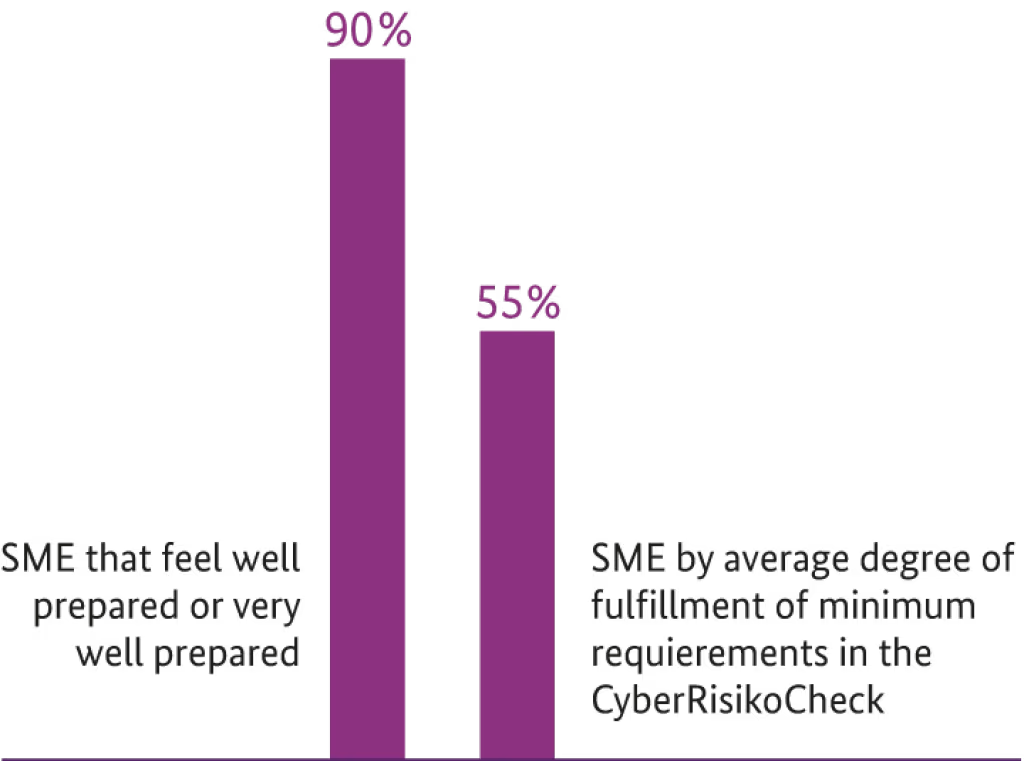 Copyright: BSI
Operators of critical infrastructures, by contrast, have been legally regulated for a longer time — and are better protected. But there is also room for improvement here. The share of operators of critical infrastructures whose information security management systems and business continuity management systems reach maturity level 3 and thus meet the legal minimum requirements remained largely unchanged at 78 % and 65 %, respectively, while the share of intrusion detection systems at implementation level 3 rose to 55 %.
Consumers: Fewer Than Half Use Basic Security Measures
Carelessness continued in the private sphere: Although one in ten people is affected by cybercrime every year, even the best-known and most common cybersecurity measures, such as secure passwords, are used by less than half of the consumers surveyed. In addition to the feeling of being safe, feeling overwhelmed was cited as the reason for this. Even simple measures (see "Basic Tips for IT Security") could contribute to greater security.
The BSI for Cybernation Germany
To strengthen the cyber resilience of the state, the economy, and society, the BSI provides support in many different ways — from digital consumer protection to collecting and sharing situational information, to supporting incident management and participating in the takedown of botnets.
An important element is the systematic and targeted advice to organizations on building their cybersecurity systems — for example, with the CyberGovSecure programme, which was initiated to increase the cyber resilience of the entire Federal Administration rapidly, effectively, and measurably. The goal is to sustainably secure the operational capacity of the state in an increasingly complex threat environment. The programme is based on implementation-oriented measures, central support in implementation, and financial support for the participating agencies.
Conclusion
The state of IT security in Germany was tense and, most recently, critical in the current reporting period. Due to the ongoing digitization, vulnerable attack surfaces are constantly growing and the number of attacks is steadily increasing. The development of artificial intelligence is fueling this dynamic even further. Where exploiting vulnerabilities used to require expert knowledge and took a certain amount of time, attacks are becoming ever faster, cheaper, and more targeted.
The excuse of not being a "worthwhile target." has long lost traction. Whoever is an easy target is being attacked. Whether it is outdated software of small companies or poorly protected consumer IoT, attackers generally act opportunistically.
Yet many companies and consumers still feel a false sense of security, or even avoid dealing with their own cybersecurity because the topic seems overwhelming to them. Even simple measures such as automated patch deployment, creating backups, and using certified devices can go a long way to securing oneself and becoming a less easy target.