

As a leading economic nation and an important hub of NATO and the EU, Germany is an attractive target – both for financially motivated and state-directed cyberattacks with an ideological, political, or military background. Hybrid threats and partly AI-supported attacks intensify the situation qualitatively and quantitatively.
Therefore, the Federal Cabinet, on the initiative of the Federal Minister of the Interior, Alexander Dobrindt, decided in August 2025 that the Federal Ministry of the Interior (BMI) should develop an implementation concept for a German Cyberdome. The BSI is significantly involved in this.
What is the Cyberdome?
The Cyberdome is planned as a protective umbrella for the digital space of the Federal Republic. As a centrally coordinated early warning and protection system, it is intended to detect and evaluate cyberattacks on state institutions, critical infrastructures, companies, and society faster, and to minimize the effects and damage of the attacks. To this end, existing systems are already being networked, or sensorics are being specifically supplemented, for example at operators of critical infrastructure or voluntarily participating institutions. Automated real-time analyses systematically evaluate the information obtained and thus enable a coordinated reaction.
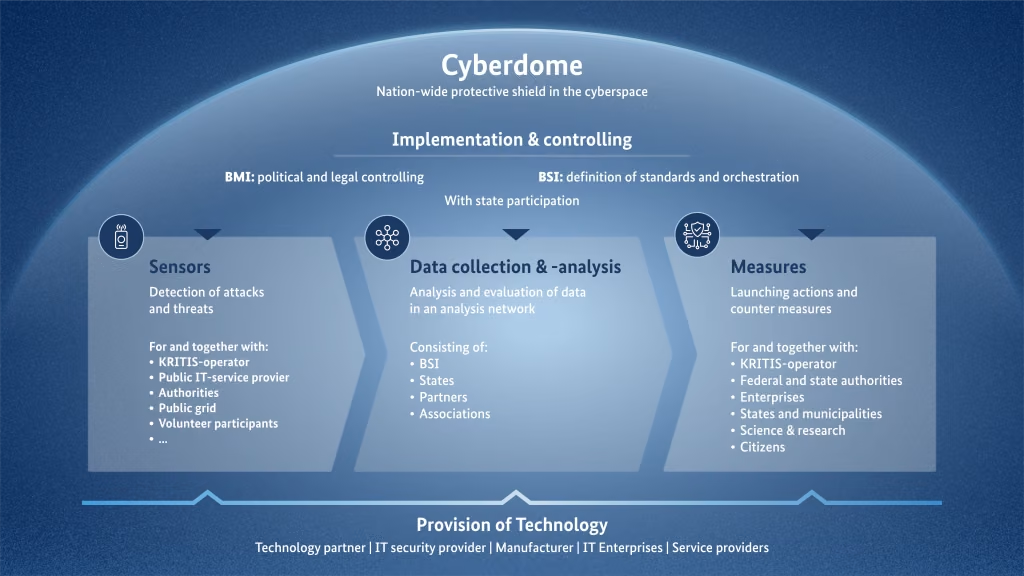
The Cyberdome is built on three pillars
1. Sensorics
This includes the building of an infrastructure that helps to better detect attack vectors and vulnerabilities in public networks, at operators of critical infrastructures, and at voluntarily participating organizations. To this end, existing systems are networked. Where existing systems have gaps, additional sensorics can be specifically supplemented. This creates a broader and earlier view of threats without intervening in the protected systems.
2. Analysis Network
In the analysis network, the information obtained through sensorics and other sources is merged and evaluated. Participants in the analysis network can, in addition to the BSI, also include partners from the public administration, the economy, research, associations, and other service providers. In doing so, basic principles such as data protection, data economy, and pseudonymization are conceptually taken into account. This allows individual indications to be connected and threats to be better detected and classified. The common situational picture that arises from this goes far beyond the view of individual organizations. Thanks to this common early warning system, findings about an attack can also help other participants to protect themselves early.
3. Measures
The Cyberdome is designed as an open technical system in which different applications can communicate with one another. To this end, standardized interfaces and open standards are used. Through these, existing technologies can be integrated and new security solutions can be added. Through the connection, it is possible for companies, KRITIS operators, authorities, or also research institutions to use the information of the analysis network automatically and to translate it into effective protective measures. In this way, a network is created that can grow with the requirements and threats in cyberspace.
What Role Does the BSI Play?
Together with the BMI, the BSI is currently in the concept and planning phase for the Cyberdome, which is to be completed by the end of 2026. The Cyberdome is being designed as a multi-year program that rescales, integrates, and bundles existing capabilities and new initiatives. To this end, the BSI is first further expanding existing services and expertise in the area of information and cybersecurity by gradually bringing new functions into use. The cooperation with other authorities and institutions of the federal government and the states also plays a central role here. In addition, actors from the economy and civil society are being actively involved in order to be able to directly address existing needs and to create sufficient acceptance among all participants.
Already in the concept phase, the BSI started in the current reporting period with first protective measures and pilot projects that were implemented as proofs of concept. The results of the pilot projects serve the further structured expansion of the Cyberdome and a gradual scaling.
- In March 2026, a first pilot project with the public IT service providers of the states and municipalities started. Here, the use of data sensorics and real-time analysis is being expanded in order thereby to improve the early warning system for cybersecurity incidents.
- In addition, the project "Deutschland-Scan" is already in operation. It is a kind of fitness check for the German Internet infrastructure. Here, the BSI checks how well this is protected against cyberattacks: in an automated broad scan, regularly around 13 million publicly reachable systems and websites are checked for vulnerabilities. In the on-demand deep scan, triggered, for example, by critical BSI security reports, findings from the broad scan are used to clarify, in a laborious detailed analysis, among other things, how the vulnerability works and under what conditions it is exploitable from the Internet. If anomalies are found, the BSI warns the affected parties.
- The BSI is also already working intensively with first KRITIS operators in the area of extended data sensorics on the building of an infrastructure for the enhanced detection of attack vectors and vulnerabilities.