


The Threats dimension proved to be tense to critical in the current reporting period. This was due in particular to new AI-supported attack infrastructures that enable attackers to carry out cyberattacks in previously unknown quantities and at unprecedented speeds (cf. Attack Infrastructures). Attackers have already significantly increased their reconnaissance activities, with which they scout potential targets on the internet and prepare cyberattacks (plus 57 %, cf. Reconnaissance Activities). The background was classic residential proxy botnets built from poorly protected Android devices, which reached new orders of magnitude in the current reporting period. This dynamic is likely to intensify considerably.
Attack Infrastructures
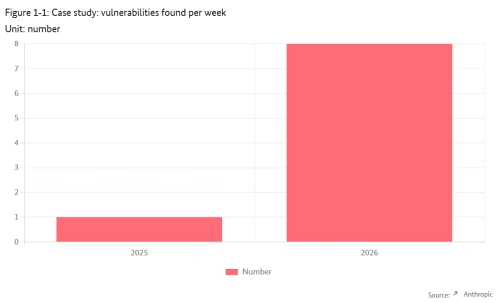
The capabilities of LLMs (Large Language Models) to identify vulnerabilities in a widely used internet browser have increased significantly in the current reporting period.
…
[more]
Attack Infrastructures
Attacker Activities
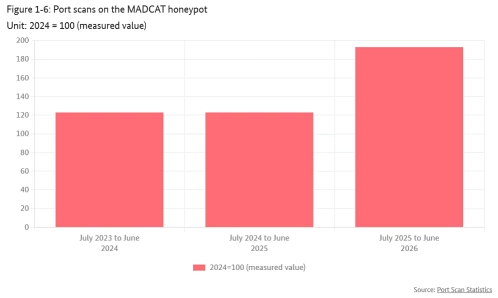
With port scans, cyberattackers search for vulnerabilities in systems that are reachable from the internet. With the exploitation of vulnerabilities (exploitation attacks),
…
[more]
Attacker Activities
Attacker Groups
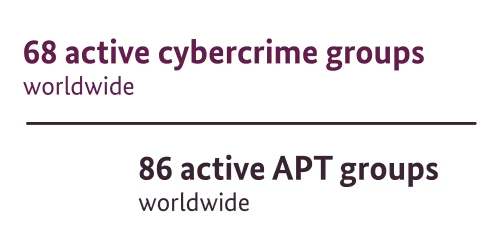
As of the reference date of 30 June 2026, 86 active APT groups and 68 active cybercrime groups were counted worldwide (cf. Figure 1‑11).
…
[more]
Attacker Groups
Hybrid Threats

Germany is in the focus of hybrid threats by foreign states, which manifest themselves through cyber operations, disinformation campaigns, espionage and sabotage operations,
…
[more]
Hybrid Threats